
Is Buying a Vacation Rental in Marco Island Profitable?
Discover if a Marco Island vacation rental is profitable in 2026. Get current AirDNA data, local tax insights, and HOA secrets from realtor Diana Villarreal.
7/7/20266 min read
As a real estate professional serving the gorgeous coastal communities of Naples, Bonita Springs, and Marco Island, I am asked one question more than any other by ambitious investors: "Diana, can I still make real money with a short-term vacation rental on Marco Island?"
It is a phenomenal question. Marco Island is a crown jewel of the Gulf Coast, famous for its crescent-shaped white-sand beaches, world-class boating canals, and laid-back tropical vibe. But investing your hard-earned capital requires looking past the palm trees and diving deep into hard data. The short-term rental (STR) landscape has transformed significantly over the last few years.
If you are looking to purchase a slice of paradise that generates sustainable passive wealth, you need an honest, localized assessment of market dynamics, regulatory frameworks, and hidden operational hurdles. Let’s break down exactly what the numbers are telling us right now.
The Baseline Numbers: What Do Investors Actually Earn?
To understand profitability, we have to look directly at realized market metrics. According to leading analytics providers like AirDNA, the short-term rental market on Marco Island holds steady with approximately 3,500 active listings.
The average annual revenue for a standard vacation rental property here hovers between $50,200 and $57,400. Properties achieve an average occupancy rate of 57% to 61% over a trailing 12-month period, commanding a healthy Average Daily Rate (ADR) of approximately $435 to $490.
However, looking strictly at the "average" is an amateur mistake. On Marco Island, real estate configuration dictating spatial layout completely changes your revenue ceiling. The market is heavily segmented, and properties that cater to specific high-value demographics outperform the averages by an astronomical margin.
The Bedroom Premium: The local market is highly dominated by larger multi-generational families and group travelers. Properties that sleep 8 or more guests (typically 4 to 5 bedrooms) frequently command annual revenues exceeding $86,000 to $123,000.
The Amenity Factor: Over 95% of active, successful listings on the island feature a private pool. In our Southwest Florida climate, a screened-in pool cage is not a luxury—it is an absolute baseline requirement for capturing premium booking rates.
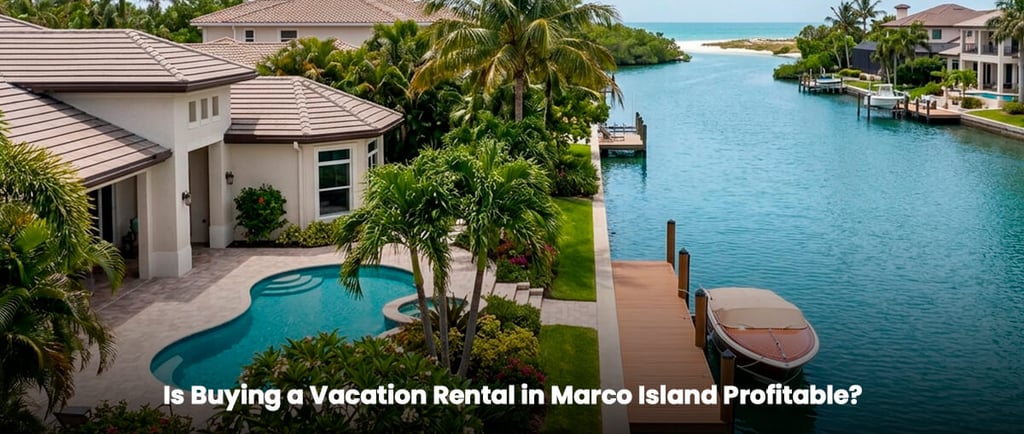
Waterfront vs. Inland: Properties situated on our extensive canal systems that feature a private boat dock with direct Gulf access capture a massive location premium from boating enthusiasts, driving both higher nightly rates and stronger off-season occupancy.
Navigating the Dramatic Swings of Southwest Florida Seasonality
If you want to maintain a profitable real estate portfolio in Collier County, you must understand our distinct seasonal cycles. Seasonality is the single most defining characteristic of the Marco Island hospitality market.
Our primary earning window runs from January through April, powered by the winter "snowbird" migration and spring breakers. March represents the absolute peak of the fiscal calendar. During this golden month, an average vacation rental property can bring in over $10,600 in a single 30-day window, running at peak capacity with nightly rates hitting upwards of $600.
Conversely, late summer and autumn represent our trough periods. September is historically the slowest month of the year, where average monthly revenue can dip to around $1,698, and occupancy drops toward 25%.
What does this mean for you as an investor? It means that cash flow planning is non-negotiable. Your winter revenue must do the heavy lifting for the entire fiscal year. A successful ownership strategy relies on building robust capital reserves during the high season to effortlessly float fixed operating costs—such as rising property insurance and maintenance—during the quieter summer months.
The 2026 Regulatory Landscape: The Truth About Local Rules
When evaluating alternative markets, investors are often terrified of hostile local governments banning short-term rentals overnight. On Marco Island, the regulatory story has taken a highly investor-friendly turn, but with a massive catch that many out-of-state buyers completely miss.
First, the good news: The City of Marco Island currently has zero municipal short-term rental registration programs.
Back in late 2023, via Resolution 23-54, the Marco Island City Council officially nullified its previous local registration ordinance (Ordinance 22-08) due to state preemption laws passed under Florida Senate Bill 250. The city does not limit the frequency or duration of short-term stays in single-family residential zones.
However, operating legally still requires strict state and county compliance. To run a seamless vacation rental business here, you must obtain and manage three specific frameworks:
State Licensing: You must secure a Transient Public Lodging Establishment license through the Florida Department of Business and Professional Regulation (DBPR).
State Sales Tax: You must register with the Florida Department of Revenue to collect and remit the 6% state sales tax on all rentals under six months.
Local Tourist Tax: You must register with the Collier County Tax Collector to handle the local 5% Tourist Development Tax. Thankfully, if you utilize major booking channels like Airbnb or Vrbo, these platforms now automatically collect and remit these tax percentages on your behalf, significantly lowering your administrative burden.
Diana’s Insider Warning: While municipal restrictions are virtually non-existent, the true gatekeepers on Marco Island are Homeowners Associations (HOAs) and Condo Boards. Many condo communities feature strict covenants completely prohibiting short-term stays, or restricting rentals to a minimum of 30, 60, or even 90 consecutive days. When working with clients, I meticulously audit the underlying association bylaws before we ever submit an offer, ensuring your intended investment strategy is fully protected.
The Strategic Edge: Capitalizing on the 2026 Buyer's Market
Market timing is everything, and the current macro-environment has handed a massive structural advantage back to buyers. As we navigate the 2026 real estate cycle across Naples, Bonita Springs, and Marco Island, inventory levels have climbed substantially.
We are currently sitting on roughly a 9-month supply of residential inventory on the island, which is well above the 6-month threshold that indicates a balanced market. Homes are spending more days on market, and average sale prices have stabilized to roughly $1.44 million—a healthy normalization from the overheated pandemic highs.
This shift means sellers are increasingly motivated. As your agent, this current climate allows me to aggressively negotiate price reductions, secure seller concessions to pay down your mortgage interest rates, or negotiate favorable repair credits during the inspection phase. Buying into a premier coastal market during an inventory expansion is historically the smartest way to lock in long-term equity appreciation.
Frequently Asked Questions (FAQ)
Are short-term rentals allowed on Marco Island?
Yes, short-term vacation rentals are fully legal and explicitly permitted on Marco Island. The municipal government does not impose caps on the frequency or minimum duration of stays for single-family homes. However, you must comply with state licensing requirements via the Florida DBPR and ensure that the specific property is not restricted by private HOA or Condo Association bylaws.
What taxes do vacation rental owners pay in Collier County?
All short-term accommodations rented for six months or less are subject to an 11% combined tax rate. This comprises the 6% Florida State Sales Tax and the 5% Collier County Tourist Development Tax. Major booking platforms like Airbnb typically manage the collection and remittance of these funds automatically.
What type of property generates the highest ROI on Marco Island?
Properties configured to host large groups or multi-generational families yield the highest returns. Concretely, single-family waterfront homes featuring 4 or more bedrooms, direct Gulf boating access, and a private screened pool consistently outperform standard 2-bedroom inland properties or restrictive condominiums.
Is Marco Island a buyer's or seller's market right now?
It is firmly a buyer’s market. With available inventory hovering around a 9-month supply and transaction volumes normalizing, buyers possess immense leverage. This environment provides excellent opportunities to negotiate favorable purchase prices and favorable contract terms that optimize your overall cash-on-cash yield.
Your Next Steps to Vacation Rental Wealth
Achieving long-term profitability on Marco Island requires pairing the right property with precise localized market data. Navigating the nuances of waterfront infrastructure, flood zones, and association rules is exactly where my expertise comes into play.
Whether you are looking to explore the hidden gems of Marco Island, the luxury enclaves of Naples, or the high-growth corridors of Bonita Springs, I am here to ensure you make a calculated, highly profitable investment. Let's connect today to review active, off-market inventory that aligns with your wealth-building goals.
@dianavnaples / (239) 641 9379
Tags: Marco Island real estate, Marco Island vacation rental profitability, Buy property in Marco Island, Southwest Florida short term rental market, AirDNA Marco Island data 2026, Diana Villarreal Realtor, Naples real estate investment, Bonita Springs investment properties, Florida vacation home ROI, Collier County tourist tax, Marco Island buyer market, Short term rental regulations Florida, Beachfront property Marco Island, Waterfront homes with docks Florida, Vacation rental management Southwest Florida, Best places to invest in Florida 2026, Airbnb revenue Marco Island, Vrbo investment properties Florida, Florida Gulf Coast real estate, Passsive income real estate Florida, HOA rental restrictions Marco Island, Florida DBPR license vacation rental